
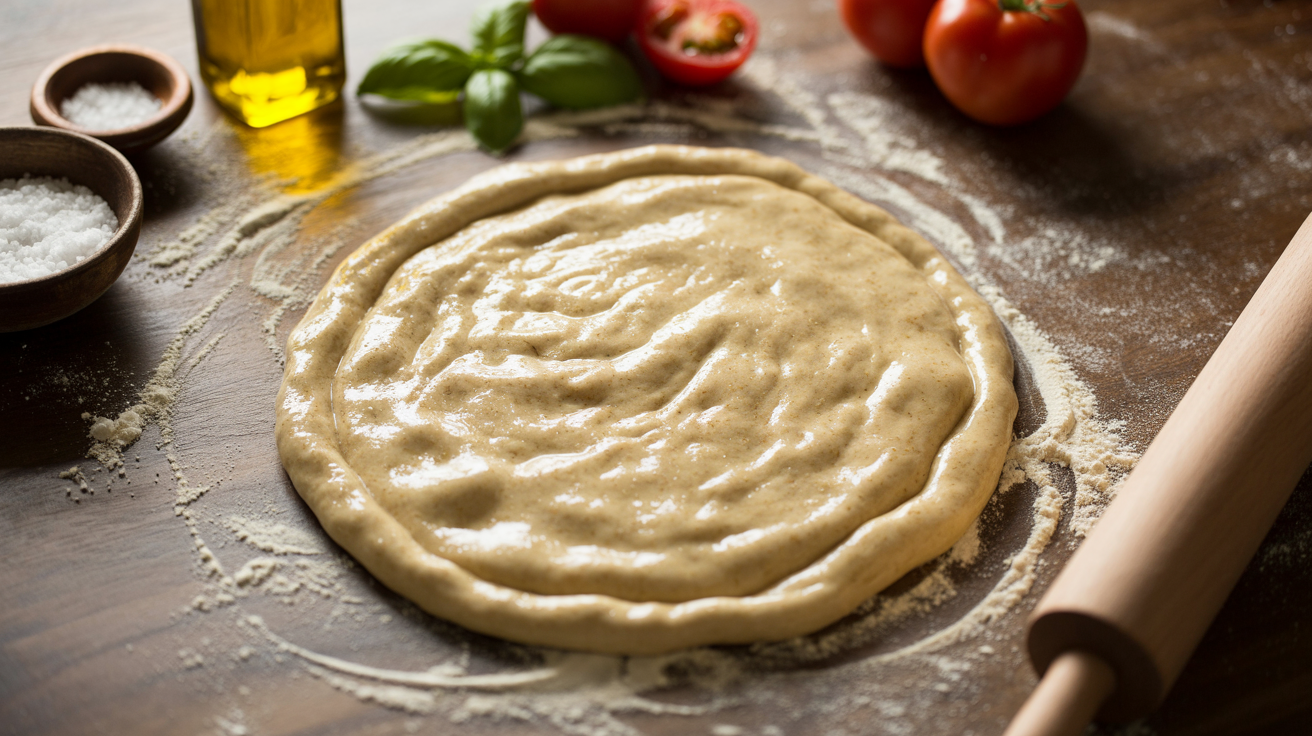
Ingredients & Measurements Table
| Ingredient | Measurement | Notes |
|---|---|---|
| Bread Flour or Tipo “00” | 3 ½ cups (450g) | Bread flour gives chew; Tipo 00 gives softness |
| Warm Water (95–105°F) | 1 ⅓ cups (320ml) | Warm but not hot |
| Active Dry Yeast | 2 ¼ tsp (7g) | One standard packet |
| Olive Oil | 2 tbsp | Extra virgin preferred |
| Sugar or Honey | 1 tsp | Helps activate the yeast |
| Sea Salt | 1 ½ tsp | Do not reduce |
| Optional – Semolina Flour | For dusting | Helps crisp the bottom |
How to Make Basic Pizza Dough (Step-by-Step Guide)
These steps are written exactly the way I personally make pizza dough at home — with little details and sensory cues you only learn after years of repeating a recipe.
Step 1: Activate the Yeast
In a small bowl, combine:
- Warm water
- Sugar (or honey)
- Active dry yeast
Give it a gentle stir and let it sit for 8–10 minutes.
You’re waiting for a creamy, bubbly foam to form on top — that’s the yeast waking up.
If nothing happens after 10 minutes?
Throw it out and start again. Lifeless yeast = lifeless dough.
Step 2: Mix Your Dry Ingredients
In a large mixing bowl:
- Add your flour
- Add your salt
Salt strengthens the gluten, but it slows yeast activity, so keep it separate until the yeast mixture joins in.
If you’re in Italy (or lucky enough to have Tipo 00 flour), you’ll notice how silky-soft the flour feels. Bread flour gives more structure — great for New York-style crusts.
Step 3: Bring the Dough Together
Make a well in the center of the flour.
Pour in:
- Yeast mixture
- Olive oil
Use your fingers or a wooden spoon to gradually mix the liquid into the flour.
When it starts forming a rough, shaggy mass — that’s perfect.
This isn’t the stage for perfection. Messy dough is good dough.
Step 4: Knead Until Smooth and Elastic
Lightly flour your countertop.
Turn the dough out and start kneading with the heel of your hands.
Push–fold–turn.
Push–fold–turn.
It becomes rhythmic after a while, almost meditative.
Knead for 8–10 minutes, until the dough transforms:
- smooth
- bouncy
- soft
- slightly tacky
When you poke it, it should spring back slowly — that tells you the gluten has developed.
Step 5: First Rise (The Magic Happens)
Shape the dough into a ball.
Place it in a lightly oiled bowl, turning it once to coat all sides.
Cover with:
- A damp cloth or
- Plastic wrap
Let the dough rise in a warm, draft-free place for 1 to 1.5 hours, or until doubled in size.
This is where flavor begins to develop.
Good dough should rise gently — not rush like it’s late for an appointment.
Step 6: Punch Down & Shape
Once risen, gently press down to release excess air.
Turn it onto your counter and divide depending on your needs:
- 2 large pizzas
- 3 medium pizzas
- 4 thin-crust pizzas
Shape each portion into a tight ball and let rest for 15 minutes before stretching.
This relaxes the gluten, making the dough easier to shape without springing back.
Step 7: Stretch the Dough (No Rolling Pin!)
Real Italian-style pizza dough is stretched by hand, not rolled.
Rolling pins crush the air pockets — those beautiful bubbles that make the crust airy.
To stretch:
- Press the center of the dough outward
- Leave a slightly thicker edge
- Lift the dough and let gravity help expand it
- Avoid tearing — be gentle
If the dough keeps shrinking back, it needs more rest.
Give it another 10 minutes and try again.
Step 8: Bake at High Heat
Pizza loves high heat.
Ideally: 475–500°F (245–260°C)
If you have a stone or steel, preheat it for at least 45 minutes.
Bake:
- 8–12 minutes, depending on thickness
- Until crust is golden and the bottom crisp
The smell alone will make your kitchen feel like a tiny Italian pizzeria.
Why This Basic Pizza Dough Recipe Works
This recipe uses the right balance of flour, hydration, and yeast activity to achieve:
- A chewy yet tender crumb
- Crisp exterior
- Elastic, workable dough
- Balanced fermentation for flavor
- Perfect texture for toppings
Using bread flour boosts gluten strength, while Tipo 00 gives a soft, silky bite.
You can even mix the two for the best of both worlds.
The olive oil adds richness and helps the crust brown beautifully.
Salt brings structure and flavor.
Sugar jump-starts the yeast and enhances browning.
It’s basic, but not boring.
Simple, but powerful.
Classic, but customizable.
Tips & Tricks for the Best Homemade Pizza Dough
After years of experience (and a few dough disasters), here are my top tips:
1. Use a Kitchen Scale
Measuring flour by cups causes inconsistency.
For perfect results, weigh everything.
2. Warm but Not Hot Water
Hot water kills yeast.
Aim for 95–105°F — warm like bath water.
3. Slow Fermentation = Better Flavor
If you have time, refrigerate the dough for:
- 24 hours
- Up to 72 hours
The cold rise creates incredible depth and texture.
4. Oil Your Hands, Not the Dough
If the dough is sticky, lightly oil your hands instead of adding more flour.
Too much flour = dry crust.
5. Let the Dough Rest Before Stretching
If the dough fights you, it’s not ready.
Rest is part of the process.
6. Use Semolina on the Bottom
It makes the crust crispy and adds a subtle bite.
7. Preheat Your Oven Longer Than You Think
30 minutes minimum.
45 minutes is better.
A hot oven equals restaurant-quality pizza.
8. Don’t Overload with Toppings
Too much sauce or cheese will weigh the dough down.
Less is more.
Frequently Asked Questions (FAQ)
1. Can I make this dough ahead of time?
Yes!
It actually tastes better when made ahead.
Refrigerate the dough for up to 3 days, or freeze for 3 months.
2. How do I freeze pizza dough?
After the first rise:
- Divide the dough
- Oil lightly
- Place in freezer-safe bags
- Freeze flat
Thaw in the refrigerator overnight before using.
3. Can I use all-purpose flour instead of bread flour?
Absolutely.
All-purpose flour makes a slightly softer crust, but still excellent.
Just avoid low-protein flour brands.
4. Why is my dough too sticky?
It’s supposed to feel a little sticky.
But if it’s extremely tacky:
- Dust with small amounts of flour
- Don’t overdo it
- Oil your hands for control
5. Why isn’t my dough rising?
Likely causes:
- Dead yeast
- Water too hot or too cold
- Room too cold
Try placing the bowl near warm appliances (but not on top of them).
6. Can I use instant yeast instead of active dry yeast?
Yes — no activation needed.
Just mix it with the flour and adjust water slightly.
7. How do I get bigger air bubbles in my crust?
Three things help:
- Higher hydration
- Cold fermentation
- Gentle handling (don’t press the edges)
Final Thoughts & Encouragement
Here’s the truth:
Great pizza dough isn’t about perfection — it’s about patience, touch, and the joy of working with simple ingredients.
Every time you make dough, you’ll learn something.
You’ll feel the difference between under-kneaded and just right.
You’ll smell when the yeast is active and happy.
You’ll recognize the soft bounce of a perfectly proofed dough.
What starts as a basic pizza dough recipe becomes a ritual, a comfort, and a small everyday pleasure.
And once you’ve mastered this dough, you’ll be able to create:
- Margherita
- Pepperoni
- White pizzas
- Veggie pizzas
- Neapolitan-style
- New York-style
- And even focaccia
So go ahead — get your hands in some flour.
Turn on your oven.
Let your kitchen smell like warm bread and toasted olive oil.
And most importantly…
Enjoy every bite of the pizza you made with your own hands.
See Also: Crispy Thin Bar Pizza Recipe How to Make Authentic NY NJ Tavern Style Pizza at Home